


Diamond Treatments By an Expert Gemologist Jinagna Shah
Diamonds are natural stones which form inside the earth's mantle due to high pressure and temperature, over millions of years. A natural diamond crystal is very different from a faceted diamond as the rough shows no brilliance or shine but is rather a dull crystal called macle. Inclusions, i.e, sm

Diamonds are natural
stones which form inside the earth's mantle due to high pressure and
temperature, over millions of years. A natural diamond crystal is very
different from a faceted diamond as the rough shows no brilliance or shine but
is rather a dull crystal called macle. Inclusions, i.e, small crystals,
feathers or needles, are clarity
features of diamonds. Some clarity characteristics
can be cut away during the manufacturing process and some can be positioned within the finished diamond in
a way so as not to affect its appearance or
durability.
While precise cutting and faceting
can considerably improve a diamond's value, treatments have been devised to
further improve its appearance. A few of these treatments are accepted by the
diamond gems industry and we will
discuss them here.
Clarity Enhancement:
1. A - Laser Drilling
Since the early 1970s, diamond
manufacturers have used lasers to drill tiny tunnels - thinner than human hair
- into diamonds to reach dark inclusions. This process uses a carbon dioxide laser to heat a tiny area of
the diamond until the inclusion evaporates .
A laser drill hole makes it
possible to gain access to the inclusions which can then be etched out with acid. This process lightens a dark
inclusion thus making the
diamond more marketable. The disadvantage of this process is that when filled with foreign material, the visibility of the inclusion becomes more
prominent.
Identification
Laser drill holes can
be detected by careful examination under a
microscope. Higher magnification is often necessary. Laser drilling can, in some cases, improve the clarity grade although the drill-hole itself becomes a clarity characteristic.
This treatment of a faceted diamond does not impact durability of the stone.
Laser drill is distinguishable from etching channels - natural, hollow, tube-like features
present in some diamonds - by the fact that laser drill holes are circular in
cross-section, while etch channels are square, triangular or hexagonal.
1. B - Internal Laser Drilling
A variation on laser drilling is
called internal laser drilling. It's a technique that uses a laser to expand
cleavage or create a new cleavage between inclusion and surface
of a crystal. This allows for the introduction of a
bleaching solution resulting in the lighting of
any dark
inclusion, making it less visible.
Identification :
The cleavage created by this procedure is more natural looking
than a traditional laser drill hole. When you examine a diamond treated with
ILD under magnification,a step-like series of tiny cleavages is visible.
These wormhole-like channels are definite signs of
ILD Treatment.
2. Fracture Filling
The Yehuda treatment, invented by Zvi Yehuda in
the early 1980’s, is a controversial treatment in the diamond
industry. Inclusions in some diamonds can be
treated by this method substantially increasing the clarity and value of the
diamond. The
term “Fracture-filled” is
sometimes used to describe these diamonds.
The Yehuda treatment involves insertion of a
particular liquid, at high pressure, into the diamond inclusion, for example,
into a feather. Although this reduces
visibility of the inclusion , it also makes the stone less durable and it
cannot withstand the cutting and setting process involved in making jewelry. This process is not permanent.
The heat from a jeweler’s torch or acid
boiling will alter the glass filler and possibly destroy the stone completely.
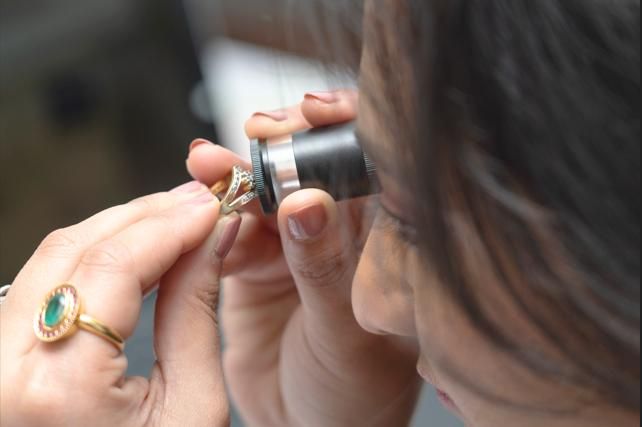
Identification:
One indication
of this treatment is the flash effect seen in these treated stones.
The typical blue or pink flashes are easily visible by rocking and tilting the
diamond. Examination under a microscope
will sometimes show iridescence and the feature become a permanent characteristic of the diamond. Gemological labs do grade laser drilled stones and report the
drill-hole as a clarity characteristic. Disclosure
from wholesaler to consumer is compulsory.
Disclosure:
Although GIA doesn’t
grade such treated diamonds, other Gem testing
Labs do grade them with the condition of Disclosure.
Colour Enhancement
IRRADIATION:
Diamonds that are naturally colored are so due
to natural irradiation during their formation. A diamond undergoes artificial
irradiation to impart color or to alter its
color. Alan
Hodgkinson notes that coloration experiments using radium salts were conducted
in the early 20th Century. A new
generation of radiation sources were used for
diamonds and other gemstones.
Irradiation produces blue, green, and dark green colored
diamonds.
Identification
To detect Irradiation treatment in diamonds is quite difficult for most gemologists and can sometimes be a challenge for the laboratory as well, as this modern technique of irradiating diamonds leaves little or no Color zoning and no radioactivity.
There are regulations on Diamond
Irradiation though,
specifically, how much amount of radioactivity is
allowed on Diamonds and Gemstones.
Color modifying irradiation treatment usually comes after cutting & polishing of the diamond. Unfortunately, irradiation colors are sensitive to heat. Technicians use cold running water to prevent color changes during the irradiation process, which generates a lot of heat. One disadvantage of this process is that the heat from jewelry repairs, recutting or repolishing might also change the color of a diamond that has undergone irradiation.

At Jinas Jewels, we ensure diamonds used in our
designs are of the highest quality.
Our founder, Jinagna Shah, is a jewelry
designer, certified gemologist and certified jewelry appraiser. Please contact
us at Jinas Jewels to get your jewelry appraised.
Disclaimer: The opinions expressed within this article are the personal opinions of the author. The facts and opinions appearing in the article do not reflect the views of 25hrNews and 25hrNews does not assume any responsibility or liability for the same.




 (+91) 8081113111
 pr@25hrnews.com